Temperature Controls

Dry Block Temperature Calibrators

A dry block temperature calibrator, also called a dry well, provides a controlled temperature for testing the sensing end of a thermocouple or RTD. Specify the setpoints, probe dimensions and reference measurement arrangement to select the block and removable insert.

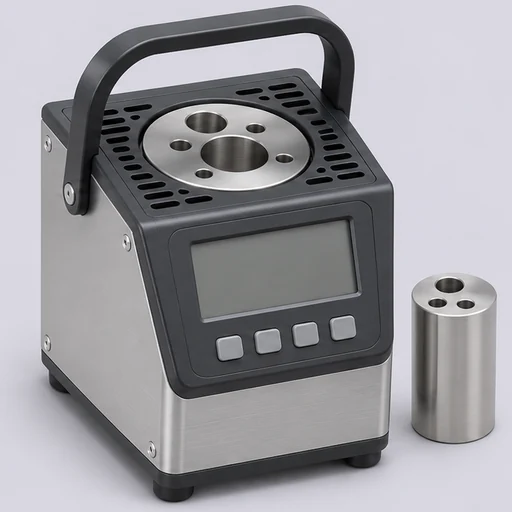
Illustration of a portable dry block temperature calibrator with a carrying handle and removable metal insert
Illustrative configuration

Configuration

Specify Your Requirements

The final construction depends on your drawing and operating conditions.

Configuration Options

  • Operating range and heating or cooling requirements by test procedure
  • Removable inserts with bores matched to the reference and test probes
  • Reference sensing and calibration documentation requirements reviewed with the application
Include in Your RFQ

  • Setpoints, operating range, acceptable settling time and worksite ambient
  • Probe sheath diameters, sensing lengths, usable immersion depths and number of probes
  • Stability over time, temperature uniformity in the insert and measurement uncertainty requirements
  • Reference probe and readout arrangement, supply voltage and documentation needed

Match the Insert and Reference to Your Probes

List the test points and give the diameter and usable insertion length for each probe. Place the test and reference sensing regions in the part of the insert with suitable temperature uniformity.

Match the Insert and Reference to Your Probes
Selection detailWhat to provide
Dry block calibratorState the required setpoints and whether any are below room temperature. Include the expected ambient conditions and time at each point.
Removable insertList bore diameters, immersion depths and the number of probes to test together. Include any stepped sheaths or mounting fittings that limit insertion.
Temperature referenceSpecify the reference probe, readout, target uncertainty and any traceability or documentation required by your procedure.
Readout input verificationFor an instrument input check, specify the thermocouple type and the signal the readout must accept.

Typical Applications

Applications include maintenance checks, incoming inspection and comparison measurements for industrial temperature probes.

Ordering Questions

How do I select an insert for a dry well?
Match the bores to the test and reference probe diameters with enough clearance for insertion. Confirm the usable depth and sensing locations so stem heat transfer and axial gradients can be assessed.
Do block stability and calibration uncertainty mean the same thing?
Stability describes variation over time at a test point. The uncertainty of a probe comparison also depends on the reference, block uniformity, immersion, probe loading and readout.

Selection Guides

Request this configuration

Include your technical requirements, target quantity and any supporting drawings.

Request a Quote