
Configuration Options
- Screw-mounted contact pads by hole and footprint dimensions
- Clamped or bonded pads by surface shape and exposure
- Pt100 or Pt1000 with two-, three- or four-wire leads by input
Temperature Sensors
A surface-mount RTD measures temperature where a contact pad sits against an equipment surface. For a custom Pt100 or Pt1000 probe, send the pad footprint, mounting method and lead exit along with the instrument model and the expected temperature at the contact point.
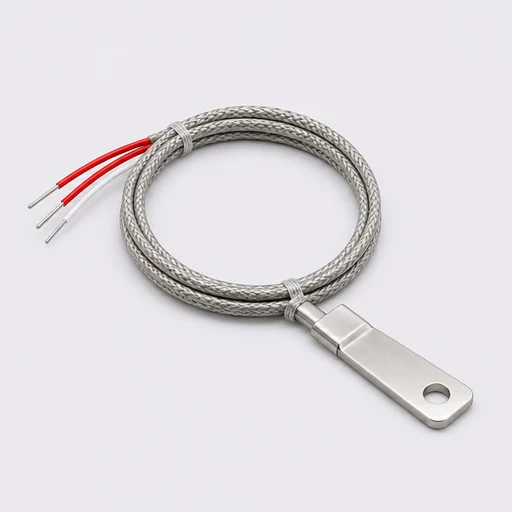
Configuration
The final construction depends on your drawing and operating conditions.
Mark the actual measurement point and show the surface profile in the area that touches the probe. Evaluate the contact method and surrounding heat transfer together for a repeatable reading.
| Mounting or wiring detail | What to provide |
|---|---|
| Screw-mounted pad | Dimension the pad footprint, hole position and diameter. Show the fastener head clearance and the direction the cable must leave the pad. |
| Clamped pad on a pipe | Give the pipe outside diameter, available contact arc, surface finish and clamp space. Mark any insulation covering the pipe and probe. |
| Adhesive-mounted pad | Specify the substrate and surface finish, temperature cycle, vibration and exposure to cleaning agents. Show room for strain relief at the cable exit. |
| Installed conditions | Give normal and peak temperatures at the contact point and lead transition. Describe any airflow or radiant heat and the response time required at the installed point. |
| Pt100 or Pt1000 wiring | Confirm the instrument model and input curve, supported wire count, tolerance requirement, lead length and connector pinout. |
Common applications include monitoring tooling, heated plates, enclosure walls and the outside of accessible pipes. For fluid or core temperature, define the measurement point within the process when selecting the probe.
Product catalog
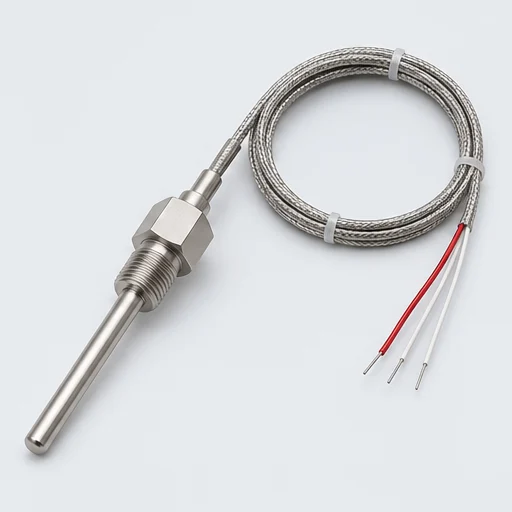
Temperature Sensors
Pt100 and Pt1000 sensor assemblies configured for your instrument and installation.
View product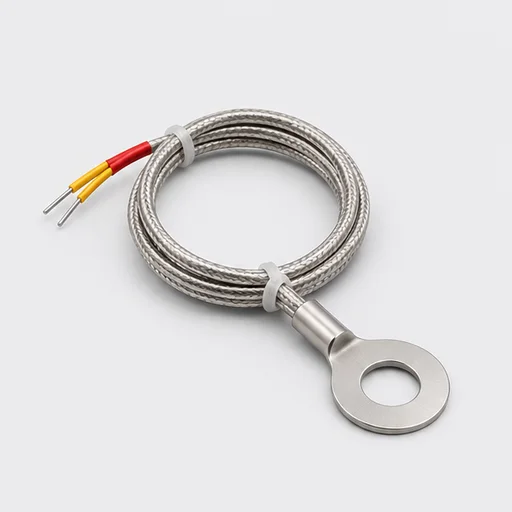
Temperature Sensors
Contact thermocouples for sensing the temperature of tooling, housings and equipment surfaces.
View product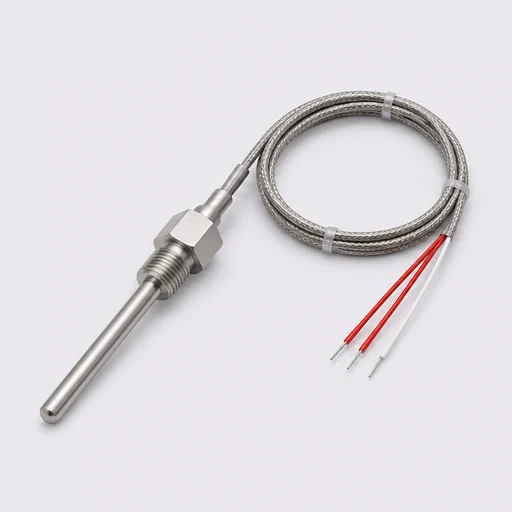
Temperature Sensors
Threaded platinum resistance probes fitted to equipment ports, thermowells and instrument inputs.
View product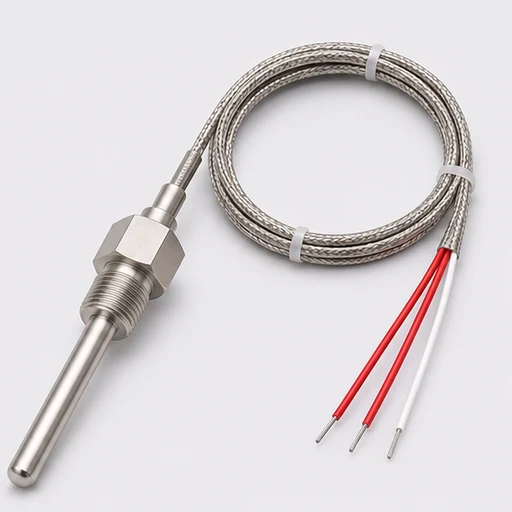
Temperature Sensors
Pt1000 platinum RTD probes configured to the process, instrument and wiring.
View productInclude your technical requirements, target quantity and any supporting drawings.